K. Jenkins
creative fantasy & mythology writer

About Me
Encyclopedic Fiction
5th Edition SRD D&D
Narrative Fiction


About Me
resident fey Loremaster

Hello, traveler!My name is Kat, and I'm an avid fan of all things fantasy, mythology, and folklore. I've been writing creatively since I could hold a pencil, with huge inspiration coming from the worlds of artists Tony DiTerlizzi, James Gurney, and Amy Brown.
My imagination has always been filled with faeries and dragons.My current focus is creating for Dungeons & Dragons and similar tabletop roleplaying systems. I have been playing D&D in its various iterations since I was about twelve years old, and I've always found its limitless creative potential unendingly inspiring.This portfolio represents work that I've completed in various online, professional projects as well as hobbyist personal projects.
☙ See where my works have been published here. ❧
Encyclopedic Fiction Samples
These are samples from nondescript, system-agnostic fantasy settings written in a less narrative, often more clinical tone, as if written by an observer or researcher.

Feywild Field Guide
Origin: unpublished original work
Word Count: 754
Alexandria Beetle (scarabaeus iskandariyya) — informally referred to as “book bugs,” these small scarab-like creatures manifest in neglected libraries. The circumstances surrounding their formation are vague, but they appear to spontaneously generate from dust in libraries. They range in tone, but they are almost always brown in coloration, from dark brown to cream. Their carapaces have a subtle texture to them that allows them to blend in easily with the leather-bound covers of books.
The defining trait of Alexandria beetles is their diet: they will eat the ink off a page. They are able to squeeze themselves almost entirely flat to fit between a book’s pages, and it is said that a swarm of them can devour all the words of a 500-page tome in a matter of days. Because they form from dust, well-tended libraries do not attract them.Crying Crow (corvus infelix) — stigmatized in a similar way to the banshee, these birds have a preternatural sense for misfortune. They gather in flocks proportional to the magnitude of the disaster, and some theorize that they actually subsist off of the suffering that ensues. Despite this claim, it has been proven that the crows themselves do not cause harm to befall others; they are merely attracted to it. Small flocks, called mournings, will sometimes imprint on particularly unlucky individuals or individuals who otherwise bring about misfortune.
The crying crow is named for both its mournful call and the distinguishing marks on its face: white “tear stains” that extend from their eyes to their necks. Not many have gotten close enough to see it, but some report that the eyes of crying crows are always glistening with unshed tears.Moor Mushroom (amanita paludis) — also known as the Gems of the Quagmire, this breed of toadstool appears to be spotted from a distance, very similar to the amanita muscaria of the Prime Material, but closer inspection reveals the spots to be organic gemstones. They grow in humid, wet areas such as marshlands and swamps.
Moor mushrooms have evolved a form of automimicry akin to fool’s gold. Some of the toadstools in a cluster will have worthless, “fake” gems, whereas others do have intrinsic value. These crystals can even be utilized in druidic magic as a replacement for costly material components like diamonds and gold. Interestingly, the same is not true of arcane or divine magic.
If these mushrooms are damaged in any way (such as being cut, pulled from the ground, or having their gems plucked) they will emit a thick cloud of poisonous spores. When the creature caught in the spores dies, a new bed of moor mushrooms will grow from the body. A corpse is excellent food for a fungus.
Harvesting Quagmire Gems is tedious and usually performed by removing the mushroom from the earth, careful to leave even the roots undisturbed, and then placing it in an airtight jar. These jars are set aside for the spores to settle and become inert, a process that can take upwards of twenty years, so that the gems can be safely removed. Due to how lengthy the wait, many swampland residents will invest in jarred moor mushrooms as a gift for when their children reach adulthood.Olympic Bee (apis mellifera olympia) — a subspecies of honey bee thought to have evolved due to their evolutionary predecessors’ exposure to the Feywild. One story tells of a queen bee named Mélidora who exchanged favors with an Archfey in order to bless the honey she and her hive produced with healing magic.
Physically, olympic bees might be mistaken for their taxonomic cousins the apis dorsata. Drones can measure up to an inch in length, and their wings are long and slender, sometimes with subtle variations in shape evocative of butterflies or other fey. Very frequently, they will decorate their limbs and hives with petals or small flowers from their surrounding habitat. The most striking feature of the olympic bees, however, is the pattern on their thoraces that takes on the shape of a laurel wreath.
Honey made by the olympic bee is more watery and sweet than is typical, lending to its being known colloquially as néctar. Raw néctar has minor restorative properties similar to the goodberry spell, but its real potential can be manifested when caramelized into a thicker substance called ambrousía. This confectionery has the ability to knit wounds together, to palliate fatigue, and even alleviate magical exhaustion. Such concentrated restoration magic can be very dangerous when taken in excess. The extent of its abuse has not been recorded.
Aurelians, the Eternal Chrysalides
Origin: Tome of Pacts
Word Count: 472
aionia chrysallida
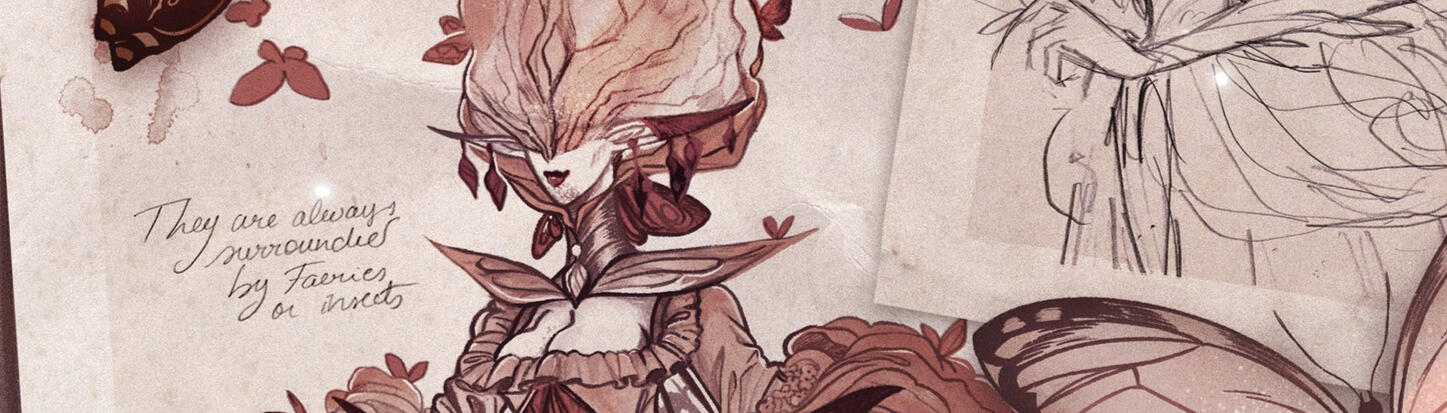
Despite a close association with Lepidoptera, Aurelians have a purpose much more reminiscent of gyne from the order Hymenoptera. These “Queen Bees” of the fey world appear biologically designed to create more faeries through a sort of consensual parasitism, often under the false guise of mutualism.
Deep within the forests of the world, in those areas that straddle the veil between the Material and the Plane of Faerie, lie extravagant ruins transformed into ethereal havens for an assortment of moths and butterflies as well as several smaller fey creatures. The caretakers of these interplanar sanctuaries are a towering breed of insectoid faerie known commonly as Aurelians.An important member of the fey court system due to their agamic abilities, Aurelians will take on more comely, near-humanoid appearances to appeal to potential hosts. According to what limited anecdotal research exists, no two disguises are alike. Each Aurelian takes on their own persona to appeal to the type of host they seek. Documented cases describe a motley cast ranging from helpless crones and charitable hierophants to beautiful maidens and crestfallen harlequins. No matter the likeness they choose to mimic, Aurelians are distinguishable by their insect-like extremities; an iridescent, almost glassy chitin; gossamer wings; and compound eyes—all hallmarked traits of the species.It is important to note that however intimidating an Aurelian’s presence, they are non-hostile so long as they remain unthreatened. In fact, Aurelians pride themselves on their hospitality toward those lost wanderers who stumble upon their ancient sanctums, as this is the pool from which Aurelians must choose their hosts.While not inherently evil, Aurelians—like many of their fey cousins—are duplicitous by nature. They rely on twisted truths and indirect deceptions to garner favor and credibility with those willing to offer themselves as collateral.The power an Aurelian gifts its warlocks is so potent that it transforms them into fey creatures. The mark of such a pact is a glass-like appendage that appears to be filled with petals, wings, or other insect parts—much like a chrysalis. The more dedicated a warlock, the more of their body they forfeit to become obtect nurseries for these burgeoning fey.A deal, once accepted, is nearly impossible to renounce. Parasitic fey prostheses are able to induce mood-altering chemicals like serotonin, dopamine, and adrenaline. This ability introduces an addictive quality that impels warlocks to return to their Aurelian patron until they give over their entire body, allowing the fey growing inside to finally take over their host.A select few warlocks seem to have worked out a more mutually-beneficial exchange, though the extent of its success is as yet undocumented. Instead of surrendering their own forms, these cunning charlatans will find others to take on the parasitic burden in their stead. It is often said that the first sacrifice these cruel shepherds make is their heart.

illustration by Vicky Pandora

Sepulchrophos the Eclipsed
Origin: Book of Devotion
Word Count: 385
Loss need not be lonesome.
Through the hardened grief of tragedy, adamantine communities are forged.
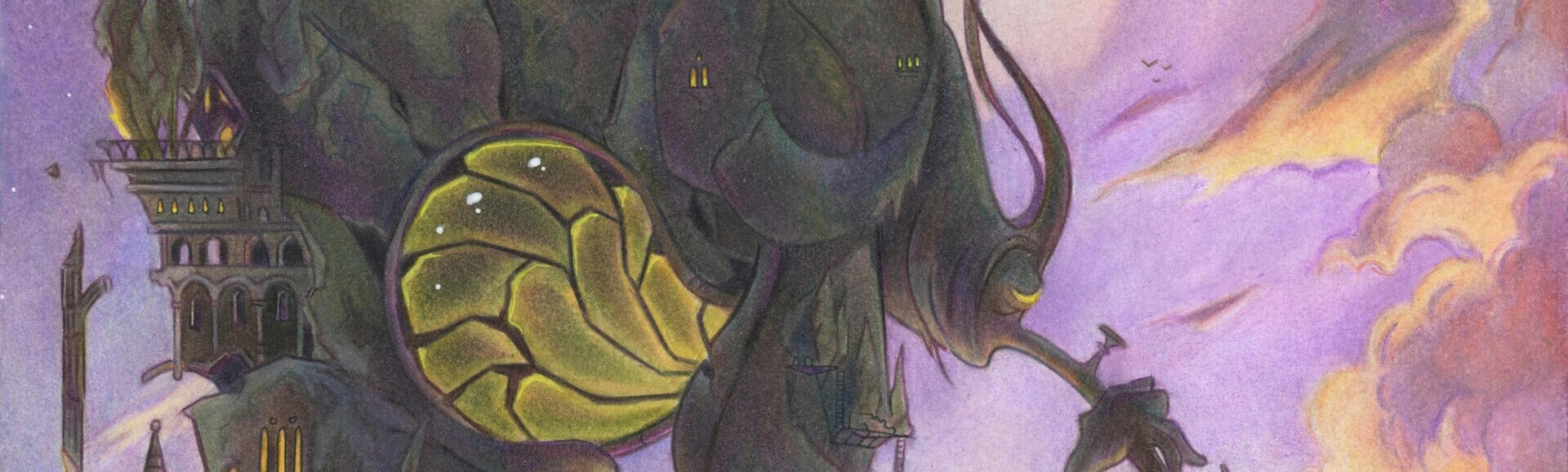
The Dying Light is a god of mourning, of endings and twilit liminality. They are the warmth in sorrow found through the company of others. Loss is not oblivion. Anguish should not be cast aside or forgotten. Sepulchrophos guides their followers to accept the hurt and the fear and the sadness. Most rituals may mourn death, but funerary rites can be enacted for lost homes or friendships or dreams just the same. Sepulchrophos embraces all with a grey tenderness.The Lost God was once the crown jewel of a sundered pantheon. Under a domain of summer skies and bountiful indulgence, they had adorned the heavens as a shining beacon. But their pantheon was not eternal, its oaths not as deathless as the lips that swore them. In the brewing theomachy, factions formed. A jealous and cruel tribunal ripped the heart from their chest and cast them from the sky.The shattered star crashed to the earth, and a veil of shadow settled over the land in its wake. For centuries, it remained in deep torpor, hidden away in its pain and shielded from the outside world beneath an armored carapax while war ravaged the realms of both man and god.A Lamplighter and her flock were the first to find the Darkened One. The refugees built their homes on the god’s back, and every day they gave thanks to it. As their community grew, they told the sleeping god of their struggles and the triumphs they found in their shared suffering. Piece by broken piece, their constant presence and unwavering faith restored the god.Sepulchrophos awoke, recrudescent, as nothing more than the animate exuvia of what they once were. They now wander the hills, lowing a mournful melody on a knotted salpinx and carrying with them the town of their most faithful. They often appear, portentous and looming, at sites of massive casualty—warzones, hospitals, graveyards—where people seek the most guidance.Six temples were founded to honor Sepulchrophos, erected wherever the god’s divinely spilt blood, known as stardrops, had made landfall in the Descent. The seventh of these was safely entombed in the cavern of their empty chest so that they might always be a guiding light to those in need.

illustration by Eliot (The Nothing Maker)

Narrative Fiction Samples
These samples are largely from nondescript, system-agnostic fantasy settings written in a more flowery, narrative tone.The excerpt from Hyakinthos is a longer-form narrative including dialogue inspired by the myth of Apollo and Hyacinth.
The Lachrymore
Origin: Tome of Pacts
Word Count: 506
The Weeping Wanderer is an entity of true neutrality. Its wailing reaches out to all who might hear its plea—the wretched, the hopeful, the lost, the sadistic, the hurt—and it asks them for more.
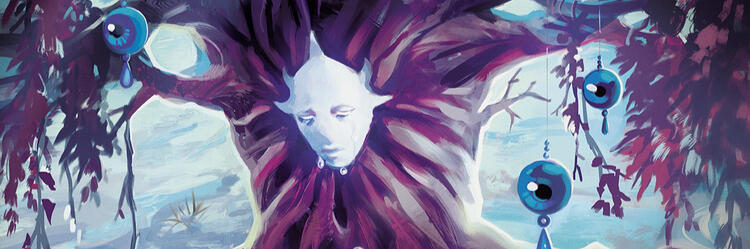
The Feywild is more than gilded promises and effervescent celebrations that dance in the golden light of eternal dusk. Its honeyed whispers fall silent in the haunting mists of the Deepwood, in the face of the creatures that roam within.Far past the outer groves, beyond gnarled thickets and eerie moors, sits an ancient temple long abandoned. Its courtyard is a tangled mess of roots and unearthed secrets—the clear aftermath of something no longer bound to the soil and a reminder that these woods were not always filled with the dolorous song of echoing wails. The temple had been well-tended once, and a great tree had flourished in its court.To the fey, history is not steadfast law but a liquid understanding of multiple truths. Several of these truths weave the tale of a sapling grown from a solitary branch in the murk of the Deepwood. They tell of the peculiar taste this seedling developed early in its nascence. The temple’s tree was watered with tears and hushed words, forces powerful enough to stir a new sentience within it.The Lachrymore no longer stays rooted. It has grown and twisted into a hulking, sphinxlike creature with a bovine body and a face of ivory inset in its bark. Those who seek counsel with the Weeping Wanderer and kneel in supplication before it are often met with sinister and cruel remarks from the creature that lives in its boughs.Accounts differ on exactly how and when this second entity came to exist. Most sources agree that the creature simply emerged from the shadows one day and became a steadfast companion of the Lachrymore to the point of indistinguishability. Perhaps it was once a white dove that came to rest amid the tree’s many branches only to be caught in its intense gravity of grief and lost hope until the dove was dyed an umbral black from the Wanderer’s canopy and the darkness therein.The Shadow collects the pearlescent sap that flows from the eyes of the Lachrymore’s alabaster mask, and it spins the sap’s milky consistency into an azure crystal not dissimilar to amber. These gems decorate its branches alongside talismans crafted from the material combined with profound, ancient magics.The Lachrymore presents the most powerful of these charms to its followers in exchange for its favored nutriment: memories held within tears. Despair, hope, pain, and joy all have distinct properties, so warlocks will often specialize in those they excel at collecting. Oftentimes adversarial to one another, the Lachrymore’s acolytes are locked in a constant struggle to maintain their patron’s fickle favor. The older and more exotic a creature, the more unique its memories and potent its tears. The reward for such treasures incentivizes the Wanderer’s warlocks to journey far and wide, carving out a wake of destruction and desolation with each step.

illustration by tshortik

Fable Weaver
Origin: Book of Devotion
Word Count: 389
There is nothing so immortal as a story,
for it lives as long as there is a voice left to speak it.
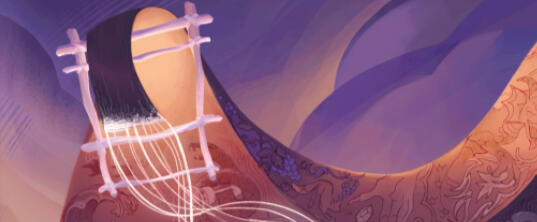
The Myth Singer began as an unrealized draft of the world, woven by the gods of creation on the Cosmogonic Loom. The gods were so in love with their unfinished opuscule that they granted it the greatest boon they could give: sentience. The cosmic script that had yet to become more sat atop its celestial plinth with a newfound awareness of the universe, and it waited.As it waited, ever so patient, it watched. It saw the cosmos reflected in its own form. It saw all the gods and their myths come to pass.And as it waited, ever so patient, it listened.It heard histories recited, discoveries made, policies enforced. But most important of all, it heard stories. Beautiful falsities spun by the mortals below, built to explain or entertain, and crafted with nothing but imagination and whim.The Fable Weaver listened, and it took in their passion and their fervor until it became a god in its own right—an everchanging tapestry of legends and tales woven by different voices through the generations.In thanks for its metamorphosis, the god plucked a single Thread of Creation from its ragged edges as a gift to humanity: a taste of the power it had received through them. This hallowed artifact now sits at the center of the Empyrean Spindle, a large temple to the Fable Weaver said to have originated from the Cosmogonic Loom itself.Pieces of the Thread are harvested by the most devout of followers, often called Silvertongues, and used as a focus to channel their magic. It is said that whenever a Silvertongue reads their spells into existence, the Fable Weaver is there to watch—as a kindly face folded into the pages of a book, or the dancing illumination on a scroll, or the shifting patchwork of a quilt.With naught but their words, these worshippers are able to weave illusions powerful enough to mimic pocket dimensions. While many use these abilities to provide an escape from the trials of reality, some brave few use it instead as a means of exploring potential solutions to the issues that plague their lives. Through story, mortals become like gods, in control of their own worlds and creations.

illustration by Cecilia Nesti

D&D 5e SRD Samples
Premise
These are original creations made for the “Celestial Shards” location in the supplemental book Fen’s Guide to Myriad Realms: #humanart.
The setting is a high fantasy floating archipelago located in a demiplane off the Astral Sea. These islands experience a cancerous overflow of magic, called the “Corruption.”Note: these entries are written for SRD and thus avoid any copyrighted terms, including the “Weave."

Luminary Ambit | Magic Item
Word Count: 357
Wondrous item, very rare (requires attunement)An ornate astrolabe that projects a small illusory star map over its face. On clear nights, it draws in the essence of extraplanar starlight to fuel its effects. The chromatic metal of its body is reminiscent of the Corrupted ore from which it was forged. This magic-infused material allows its divination capabilities a far greater reach, tearing through the veil between dimensions to access star systems across the multiverse.The ambit has 7 charges, and it regains 1d3 expended charges daily at dusk. You can use the charges in the following ways while holding it:
• Prophesied Understanding. You can expend 1 charge to invoke the ambit’s divining abilities and grant yourself advantage on an Intelligence check.
• Astral Sight. You can use your action to expend 1 charge and gain darkvision out to a range of 60 feet. This benefit lasts until you are incapacitated or you take a short or long rest.
• Starry Portent. Whenever a creature you can see within 30 feet of you makes an attack roll, a saving throw, or an ability check, you can use your reaction to expend 2 charges and roll a d4 and apply the number rolled as a bonus or penalty (your choice) to the original roll. You can do this after you see the roll but before its effects are applied. You may also choose to increase the bonus or penalty by 1d4 for each additional charge expended.
• Nocturnal Aurora. As a bonus action, you can expend 5 charges to surround yourself in a swirling field of corrupted starlight. Until the end of your next turn, you gain resistance to all damage. Additionally, while the aurora is active, if you are damaged by a creature within 60 feet of you that you can see, you can force that creature to make a DC 15 Charisma saving throw as it is wreathed in dripping stars. It takes radiant damage equal to your level + your spellcasting modifier on a failed save, or half as much damage on a successful one.Intelligence, Wisdom, or Charisma is your spellcasting ability for this item (choose when attuning).

illustration by magical kaleidoscope


Ikarion | Species/Lineage
Word Count: 1823
The Corruption of the Celestial Shards is unforgiving and ruinous. The lush, prismatic landscape of its floating isles belies a sinister arcane ruination. Stepping foot on their doomed shores lights the fuse of an ever-shortening mortal coil.Of these beautifully deadly expanses, one of the most chaotic and dangerous is the shifting, crystalline expanse of the Sun-Blighted Lands, where the Sun Celestial lingers in a comatose state of suspended Corruption. The unique nature of the Sun’s Corruption makes it a tantalizing curiosity for conceited scholars and wizards, as well as a challenge of strength and durability for arrogant warriors. This hubris leaves a permanent mark on those that survive, morphing them into creatures known as Ikarion.These “Sunkissed” individuals hold an erratic command over the arcane energies of the universe — many buffeting against its currents more than harnessing it in a studied fashion. The Ikarion are a glorious display of the magical corruption in the Celestial Shard, tainted by its infection in very visible and tangible ways, but seemingly immune to its spread.A likely untold number of dead line the valley of the Sleeping Sun — proud adventurers who flew too close to its light in vain attempts to replicate the perilous process and become Sunkissed themselves.
Ikarion Origins
While many Ikarion can pinpoint the events that led to their eventual metamorphoses, they are also very aware of the tragedy that might befall an adventurer endeavoring to reproduce the same results.The Sleeping Sun’s blessing is fickle and unstudied. Some scholars posit that perhaps exposure to the Corruption simply awakens latent arcane affinities already present in certain individuals.
| d6 | Origin |
|---|---|
| 1 | You are a scholar who wandered too deep into the Sun-Blighted Lands. |
| 2 | You picked up a corrupted fragment from the Celestial Shards and exposed yourself to it for too long. |
| 3 | You believed yourself strong enough to withstand the Corruption’s harsher effects and pushed further than you should have into dangerous territory, emerging as something new. |
| 4 | You woke up one day after a fitful dream with the Sleeping Sun’s blessing. |
| 5 | A party member brought the Corruption back to your shared camp. You are the sole survivor of the outbreak. |
| 6 | You’ve been this way for as long as you can remember. The Corruption is all you know. |
Signs of Corruption
The favor of the Sleeping Sun rarely graces a being without leaving its mark. The twisted magic of the Celestial Shards often leaves a toll on the body, distorting it into something more than it was. Newborn Ikarion sometimes act as a conductor for the shimmering prismatic light of Corruption, marking their Sunkissed status.Some signs of corruption are small and easily concealed, but others spread over time to the point where an Ikarion’s body is fully consumed by their effects.
| d8 | Sign |
|---|---|
| 1 | Motes of chromatic light generate from your body. |
| 2 | Your skin takes on an oil slick iridescence. |
| 3 | Natural elements of the land fuse with your body. |
| 4 | Crystalline structures like horns, spikes, halos, or other growths sprout from your skin. |
| 5 | Your eyes have a glowing pearlescent film over them. |
| 6 | Veins of light splinter over your skin, constantly shifting and reforming. |
| 7 | You gain bioluminescent properties that flicker over your body and objects you hold. |
| 8 | Your weapons or armor fuse to your body, becoming a permanent fixture. |
Empyreal Destiny
Those touched by the Sleeping Sun are known to undergo a metamorphosis of self, both physically and mentally. Many who bear witness to this change are quick to blame the Corruption’s influence, claiming it eats away at the mind and soul. The affected Ikarion, however, cite feelings of enlightenment and a clearness of perspective they previously lacked.Ikarion who have experienced such a transformation of personality trend towards neutrality and are more likely to take on an almost spiritual worship of the Shards’ Celestials, sometimes going so far as to declare themselves Chosen Guardians of the Sleeping Sun. They often have a heightened sense of self importance, considering themselves to be evolved by the Corruption due to their unique interconnection with the disturbed magic energies of the Shards.Many who do not undergo this cosmic erudition fear its hold. A strong-willed or newly awakened Ikarion might see this change as a loss of individuality, an arcane lobotomy, and fight furiously against it by adamantly maintaining and reaffirming their identity outside the kiss of the Sleeping Sun. Others may see it as an inevitability, taking on a more deterministic approach and actively choosing to continue enjoying their life as it was, despite the threat looming ever-present over them.
Arcane Outcasts
Ikarion are largely solitary individuals, whether by choice or by superstition, refusing to coalesce into a larger community structure with others of their kind for fear of what their concentrated Corrupted magic might create.Oftentimes, the uninfected will ostracize them, assuming their Corrupted state was self-inflicted or simply deeming them too reckless. However, many continue adventuring, either in the parties with whom they first journeyed to the Celestial Shards or with new party members found along the way.The two native species of the Shards have vastly opposing views of the Ikarion. The lunar denizens of the Moon Archipelago have a great distaste for the Ikarion. A very communal species, the Botophin denounce the Ikarion as selfish entities who brought about their own destruction by pursuing a forbidden knowledge. The Stellanati, by comparison, recognize the pull of curiosity and do not condemn the Ikarion for their folly. Instead, these astral nomads have been known to welcome the Sunkissed into their clans in order to observe and learn more about them.
Ikarion Traits
Ability Score Increase. Increase one ability score by 2 and increase a different one by 1, or increase three different ability scores by 1. If you are replacing your race with this lineage, replace any Ability Score Increase you previously had with this.
Creature Type. You are a Humanoid or Fey. You choose the type when you gain this lineage.
Size. You are Medium or Small. You choose the size when you gain the lineage.
Speed. Your walking speed is 30 feet.
Ancestral Legacy. If you replace a species with this lineage, you can keep the following elements of that species: any skill and language proficiencies you gained from it and any climbing, flying, or swimming speed you gained from it.
If you don't keep any of those elements or you choose this lineage at character creation, you gain proficiency in two skills and one language of your choice.
Magic Resistance. You have advantage on saving throws against spells. Additionally, you are immune to the Corruption of the Celestial Shards.
Solar Resilience. You have resistance to radiant damage.
Corrupted Boons. The Corruption affects each Ikarion differently. When you gain the lineage, choose one of the boons below.Aetherial Wings
You’re able to wrap yourself in an unstable magical aura and glide along it.
As a bonus action, you can gain a flying speed equal to your walking speed until the start of your next turn while you aren’t wearing medium or heavy armor. Your next turn, you have a speed of 0 as your body takes time to readjust to the flow of magic.
You can use this boon a number of times equal to your proficiency bonus, and you regain all expended uses when you finish a long rest.Scion of Light
Your altered body acts as a conduit for the tethered power of the Sun Celestial.
You know the Dancing Lights cantrip. Starting at 3rd level, you can cast the Guiding Bolt spell with this trait. Starting at 5th level, you can also cast the Branding Smite spell with this trait.
• You can cast Guiding Bolt or Branding Smite with this boon a number of times equal to your proficiency bonus without expending a spell slot, and you regain all expended uses when you finish a long rest. When you cast a spell in this way, you take radiant damage equal to your proficiency bonus as your body overflows with unstable arcane energy. This damage can’t be reduced in any way.
• Intelligence, Wisdom, or Charisma is your spellcasting ability for these spells when you cast them with this trait (choose when you select this lineage). You can also cast either of these spells using any spell slots you have of the appropriate level without taking damage.Sungazer’s Eyes
Your prolonged exposure to the Sleeping Sun has permanently altered your sight. The essence of magic reveals itself to you, but the pervasive weight of darkness has deepened.
You have advantage on saving throws against being blinded by light and can cast detect magic at will, without expending a spell slot or material components. However, you have difficulty seeing in low light. You may no longer gain the benefits of Darkvision, and dim light acts as darkness for you.Unnatural Armor
Your armor has fused to your body through the power of the Corruption.
• You gain a +1 bonus to Armor Class.
• To doff your organic armor, you must spend 1 hour removing it through a rigorous and painful process.
• You can fuse new armor to your being by donning it. You can don only armor with which you have proficiency. To don armor, you must allow the Corruption to merge it into your body over the course of 1 hour, during which you must remain in contact with the armor.
• While you live, your armor can't be removed from your body against your will.
• While your armor is fused to your body, you have disadvantage on initiative and stealth rolls as the fused armor stiffens your joints.
• Sleeping in fused armor has no adverse effect on the wearer, though it is far from comfortable.
Creating an Ikarion
The chaotic multitudes of the Corruption cannot be predicted, but that does not mean they are without logic. When considering the aesthetic changes or Corrupted Boons brought about by taking on the Ikarion lineage, consider your character’s class, background, and personality.A warlock with a Fiend patron might become fiendish themselves, now boasting horns and a tail made from kaleidoscopic crystal. A Divination wizard’s overactive psionic talents might cause their mind to be attacked by the Corruption first, deteriorating their sense of self before it even takes a visual hold of their body.The warped arcana of the Celestial Shards might latch onto a rogue’s inherent inclination towards escape and grant them flight in a more literal sense, or it might sense a druid’s deep attachment to the earth and unite them with it, forming an organic armor around their body to craft them into a natural bulwark.It’s also important to take into account how the Corruption might have affected your character’s personality. Are they the same as they were before? Or has this life-altering experience changed them into something entirely new? How has the acquisition of this lineage affected their interpersonal relationships?

illustration by Andreea Sava


Hallowed World Conclave | Ranger
Word Count: 856
Wardens of the Hallowed World Conclave have seen the twisted darkness within the resplendent beauty of the Corruption that pumps through the veins of the Celestial Shards, and they have sworn to fight back against it. They view unfettered magic as a lethal plague and believe that any who seek to use it in excess are a danger to those around them.These rangers are most often found closer to the ruins of the Lucetium or in the Sun-Blighted Lands, where the Corruption is strongest, but they patrol the Celestial Shards as a whole, acting as a localized antitoxin to the more egregious areas of arcane rot.
Sublunary Devotion
The founders of the Hallowed World Conclave were firm believers that the Lost Celestial was the source of the Corruption, and its mistreatment led to the Great Shattering. They viewed the World Celestial as a martyr of unnecessary sacrifice and condemned the Lucetians responsible for violating it.Belief in the Hallowed World entity varies throughout the Conclave. Some worship it as a deity; some believe it to be more symbolic spiritualism, a kind of dogma to follow; and others still view it as a parable for the lands of the Shards as a whole. But despite differing creeds, all hallowed wardens recognize the importance of fighting back against the Corruption.
Everything in Moderation
The unique nature of the tainted magic infused in every stone of the Celestial Shards can make it difficult or even dangerous for Druidic magic to be performed. The mystic veil from which all casters draw their energy is asynchronous and overabundant in the Shards, redoubling on itself like a volatile arcane cancer. Some believe that disturbing this tenuous balance by casting a spell risks exposure to the Corruption’s sickening touch.When a hallowed warden draws their power from the natural world around them, they must first tether it. They have unlocked the secrets of antimagic, diluting the superfluous energy until it bends to their whim—creating order from chaos. This ability allows them a greater understanding of the flow of magic and the arcane as a whole, which they use in their order-driven path to restore nature to its original form.Hallowed wardens do not hesitate to use magic for their own ends, nor do they see magic as a great evil. The enemy they fight in the Corruption is excess, and they only seek to stabilize the Shards and reverse the damage wrought by the overexertion of the World Celestial.
Hallowed World Features
| Ranger Level | Feature |
|---|---|
| 3rd | Hallowed World Magic, Blighted Necrosis, Esoteric Knowledge |
| 7th | Arcane Fortitude |
| 11th | Antimagic Aegis |
| 15th | Mystic Reflection |
Hallowed World Magic
Starting at 3rd level, you learn an additional spell when you reach certain levels in this class, as shown in the Hallowed World Spells table. The spell counts as a ranger spell for you, but it doesn’t count against the number of ranger spells you know.
Hallowed World Spells
| Ranger Level | Spell |
|---|---|
| 3rd | arms of hadar |
| 5th | lesser restoration |
| 9th | dispel magic |
| 13th | blight |
| 17th | hallow |
Blighted Necrosis
At 3rd level, you can augment your weapon strikes with the necrotic power of the corrupted World Celestial. Once during each of your turns, you can deal an additional 1d6 necrotic damage to one creature you hit with a weapon attack.When you reach 11th level in this class, the extra damage increases to 2d6.
Esoteric Knowledge
Also at 3rd level, your devotion to understanding the arcane and its effect on the natural world grants you heightened awareness of the supernatural. You gain proficiency in Arcana and gain a bonus to any Arcana check equal to your Wisdom modifier (minimum of +1).
Arcane Fortitude
At 7th level, your uncanny awareness of the magic around you gives you additional resistance to its effects. You have advantage on saving throws to end magical effects on yourself, such as ending the paralyzed condition of hold person.In addition, you have advantage on saving throws to maintain concentration as the chaos of magic tames at your touch.
Antimagic Aegis
At 11th level, you learn to temporarily separate magical energy around you from the multiverse. As a bonus action on your turn, you can cast the antimagic field spell with this feature using a spell slot of any level, but with the following changes:
• The spell’s duration is concentration, up to a number of rounds equal to your proficiency bonus.
• You and any equipment you carry are immune to the effects of the spell.
• When you cast the spell, you can designate a number of creatures also immune to the field’s effects equal to the level of the spell slot used to cast it.Once you use this feature, you can’t use it again until you finish a short or long rest.
Mystic Reflection
At 15th level, you gain the ability to turn your enemies’ magic back on them. When you succeed a saving throw against a spell, breath weapon, or other magic effect, you can use your reaction to cause the effect to also target the caster, using the same slot level, spell save DC, attack bonus, and spellcasting ability of the caster.

Corrupted Weaponmaster | Fighter
Word Count: 1549
Corrupted Weaponmasters are fighters who have spent too long in the scourged lands of the Celestial Shards and now wield the unbridled danger of the Corruption with ease. The archetypal Corrupted Weaponmaster is a one-man armory, harnessing the inconstant nature of the Corruption to alter their weaponry on a whim, shaping it to whichever form suits their next combat best.Though many consider this strange symbiosis with the Corruption a type of curse, Corrupted Weaponmasters believe in their ability to fight back its darker effects and use the abilities they gain from it for the greater good.
Seed of Ruin
The protean manifestations of the Corruption in the Celestial Shards make it nigh-impossible to predict. The malignant magic often coalesces into natural phenomena like crystal rain, whispering winds, or mirrored sands. But there have been numerous notable instances of the Corruption being drawn to physical items of significant importance, even if they are initially nonmagical in nature.It is believed that some kind of eldritch, unknowable sentience seeks out strong emotional tethers between the living and their possessions. A corrupted locket might have an animated illustration within; a corrupted spellbook might unpredictably enhance a wizard’s spells; and a corrupted sword’s blade might bubble with a ferrofluidic grace, thrumming with new transformative capabilities.
Arcane Synergy
The proposed pseudo-sentience of the Corruption is further exhibited in its ability to transfer between objects, suggesting that it is more closely linked to its host creature than with the item it originally inhabited. Beyond this physical mutability, it is not uncommon for Corrupted Weaponmasters to experience a change in personality after bonding with the Corruption. Most infer it to be a result of the rush they feel from being connected to the veil of magic in a way they had never experienced before and consider themselves to be better for the change.Corrupted Weaponmasters are rarely experts in the arcane—in fact, very few explicitly study it. However, many claim to understand its properties innately. They assert that their morphosis into a conduit for the unstable energies of the Celestial Shards gives them a unique insight on the very essence of magic.
Inoculation or Sensitization?
As a DM, you should decide how your Corrupted Weaponmasters’ relationships with their blades affect their susceptibility to the Corruption as a whole.While prolonged exposure to a small amount of Corruption in a controlled setting might make them more resistant to its effects (which can manifest as advantage on saving throws versus Corruption taking hold or spreading), you could just as easily rule that a corrupted weapon seeks to lower its host’s defenses and make them more likely to succumb to Corruption as a whole (granting them disadvantage on saving throws versus Corruption).
Corrupted Weaponmaster Features
| Fighter Level | Feature |
|---|---|
| 3rd | Forged Corruption, Mutable Weapon |
| 7th | Unstable Surge |
| 10th | Parasitic Symbiosis |
| 15th | Anomalous Awareness |
| 18th | Lucid Valediction |
Forged Corruption
Beginning when you choose this archetype at 3rd level, you can harness and transfer the magical Corruption that lingers in your blade.Whenever you finish a long rest, you can touch one simple or martial weapon, transferring the Corruption into it and making it a weapon bonded to your arcane essence.
• If the weapon is nonmagical, it becomes a magic item for you, granting a +1 bonus to attack and damage rolls.
• If the weapon is magical, the Corruption Transference will fail if someone else is attuned to the weapon or another Corrupted Weaponmaster has bonded with it. You also can’t affect an artifact or a sentient weapon in this way.
• Your corrupted weapon becomes inert if it is more than 5 feet away from you for 1 minute or more, if you use this feature again on another weapon, or if you die.Once you use this feature, you can't use it again until you finish a long rest.
Mutable Weapon
Also at 3rd level, you can use your bonus action to change the appearance of your corrupted weapon. It takes on the properties, damage die, damage type, and weight of its new form. If your corrupted weapon is magical, it retains all applicable features in its new form as determined by your DM. (For example, a quarterstaff that can cast bless is able to transform into a short sword that can cast bless, but a bow that magically creates its own ammunition when transformed into a war hammer would simply count as magical for the purpose of overcoming resistance and immunity to nonmagical attacks and damage.)You can use this feature a number of times up to your proficiency bonus per short rest.
Unstable Surge
Starting at 7th level, the untamed Corruption within your weapon will lash out in unpredictable waves. When you use your Action Surge feature, roll on the Unstable Surge table to determine the magical effect produced.If the effect requires a saving through, the DC equals 8 + proficiency bonus + your Constitution modifier.
| d8 | Effect |
|---|---|
| 1 | A pulse of magical energy erupts from your corrupted weapon, radiating around you in a 10-foot radius sphere. Until the end of your next turn, hostile creatures have disadvantage on attack rolls against you and your allies while within the sphere. Additionally, all creatures have advantage on saving throws against being charmed, frightened, or possessed while within the sphere. |
| 2 | The volatile magic surrounding your corrupted weapon whips out erratically, searching for something to latch onto. A creature of your choice that you can see within 30 feet of you is struck by this magic and teleports to an unoccupied space within 10 feet of you. |
| 3 | Your corrupted weapon thrums with an ethereal whispering. The next time you hit with your corrupted weapon, the target takes 3d8 psychic damage and must succeed a Wisdom saving throw or become mentally linked with you for the next minute. While linked, you always know the target's location, but only while the two of you are on the same plane of existence. While you have this knowledge, the target can’t become hidden from you, and if it’s invisible, it gains no benefit from that condition against you. |
| 4 | The abstract sentience of your corrupted weapon reaches into the minds of those around you. Each creature of your choice that you can see within 15 feet must make an Intelligence saving throw or become disoriented for 1 minute. During that time, it rolls a d4 and subtracts the number rolled from all its attack rolls and ability checks, and saving throws. It can make an Intelligence saving throw at the end of each of its turns, ending the effect on itself on a success. |
| 5 | A warm, healing light bursts forth from your corrupted weapon. Up to six creatures of your choice that you can see within 20 feet regain hit points equal to 2d4 + your Constitution modifier. |
| 6 | Your corrupted weapon flared with a dazzling array of prismatic radiance. Each creature in a 15-foot cone originating from you must succeed on a Constitution saving throw or become blinded until the end of your next turn. |
| 7 | Your corrupted weapon becomes wreathed in a dark malfeasance. The next time you hit with your corrupted weapon, the target takes 3d6 necrotic damage, and you gain temporary hit points equal to the amount of necrotic damage dealt. |
| 8 | Your corrupted weapon magically augments the adrenaline pumping through your veins. Until the beginning of your next turn, your speed is doubled, you have advantage on Dexterity saving throws, and you gain an additional weapon attack. |
Additionally, as a side effect of this enhanced arcane mutualism, your corrupted weapon no longer requires attunement for you if it previously did.
Parasitic Symbiosis
At 10th level, when you hit a creature with a melee weapon attack using your corrupted weapon, you can use your bonus action immediately after to further empower the strike by using your own life essence as fuel. Roll any number of unused hit dice and take the amount rolled as necrotic damage. This damage can’t be reduced in any way. You then deal double the amount rolled to your target and convert all damage from the attack to necrotic, psychic, or radiant damage.
Anomalous Awareness
Starting at 15th level, your bond with your corrupted weapon sinks even deeper, opening up your perception to something greater than it was. You have advantage on opportunity attacks and can’t be surprised while you are conscious. Additionally, other creatures don’t gain advantage on attack rolls against you as a result of being unseen by you.
Lucid Valediction
At 18th level, if you fall in combat, your corrupted weapon will draw upon your power to protect its host from danger.While you have 0 hit points, your weapon imposes itself between you and any attackers. Melee attacks against you do not have advantage due to the Unconscious Condition and an attack that hits is not an automatic critical hit.Additionally, your corrupted weapon can use your reaction to make a weapon attack against a creature that attacks you while you are at 0hp.Your weapon occupies the same space that you do and has a speed of 0. Attempts to wrest it from your side through either physical or magical means will require a skill check (DM’s choice) with a DC equal to 8 + proficiency bonus + your Constitution modifier.
Published Works

Tome of Pacts
by Sleepy Wyrm Creative Guild
2022
Book of Devotion
by Sleepy Wyrm Creative Guild
2024
Fen's Guide to Myriad Realms
a #humanart project
2025


